
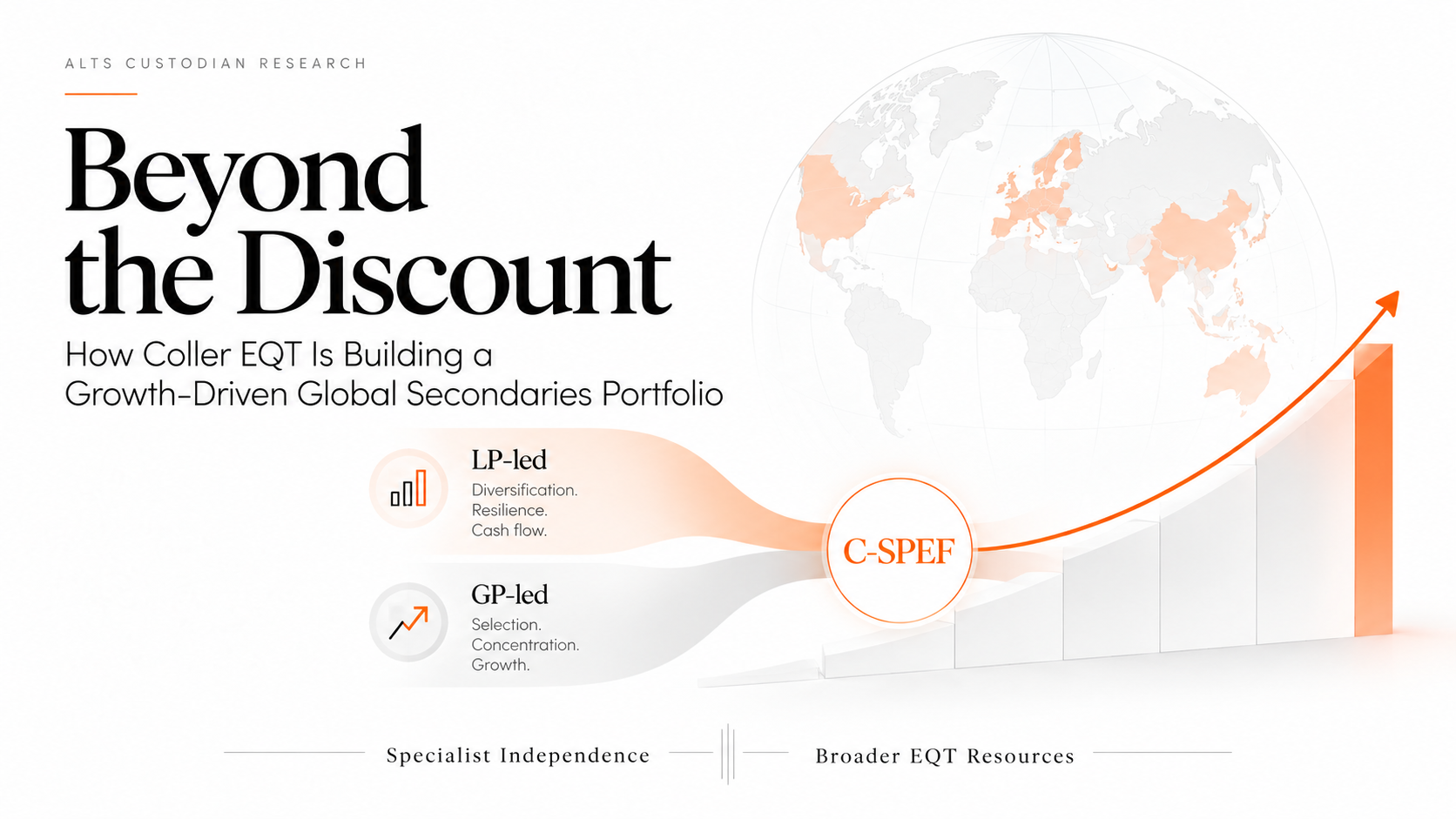
Beyond the Discount: How Coller EQT Is Building a Growth-Driven Global Secondaries Portfolio
When we started researching the Coller Secondaries Private Equity Opportunities Fund (C-SPEF), our objective was fairly straightforward.
C-SPEF had become one of the names that repeatedly surfaced in discussions with advisors evaluating private-equity secondaries. Alongside Pomona and StepStone, Coller was clearly a manager that deserved a closer look.
Then, halfway through the research, the story changed.
Coller Capital was being acquired by EQT.
By the time we were deep into our due diligence, the manager itself was going through one of the most important transitions in its history. The transaction closed on August 31, 2026, and Coller Capital now operates as Coller EQT, EQT's dedicated Secondaries business segment. The legal fund name remains Coller Secondaries Private Equity Opportunities Fund.
That made the research more interesting, but also more complicated. The Coller team was working through the transition at the same time we were asking detailed questions about portfolio construction, underwriting, cash flows, liquidity and stress behavior. We are particularly grateful to the team for making time to engage with our research during that period.
What emerged from those conversations changed the way we think about the fund.
The discount matters. But the more interesting part of the C-SPEF story is what happens after the purchase.
Secondaries are moving beyond the discount
The classic secondaries pitch is easy to understand. An investor needs liquidity. A secondary buyer acquires an existing private-equity interest below its stated NAV. If the portfolio ultimately realizes close to - or above - that NAV, the buyer benefits from the discount.
That remains part of the economics. But the secondary market has evolved considerably. GP-led transactions have become a major part of overall market activity, continuation vehicles have grown in importance, and the largest managers increasingly have to differentiate themselves not simply by finding assets below NAV, but by identifying which assets are worth owning for another four, five or seven years.
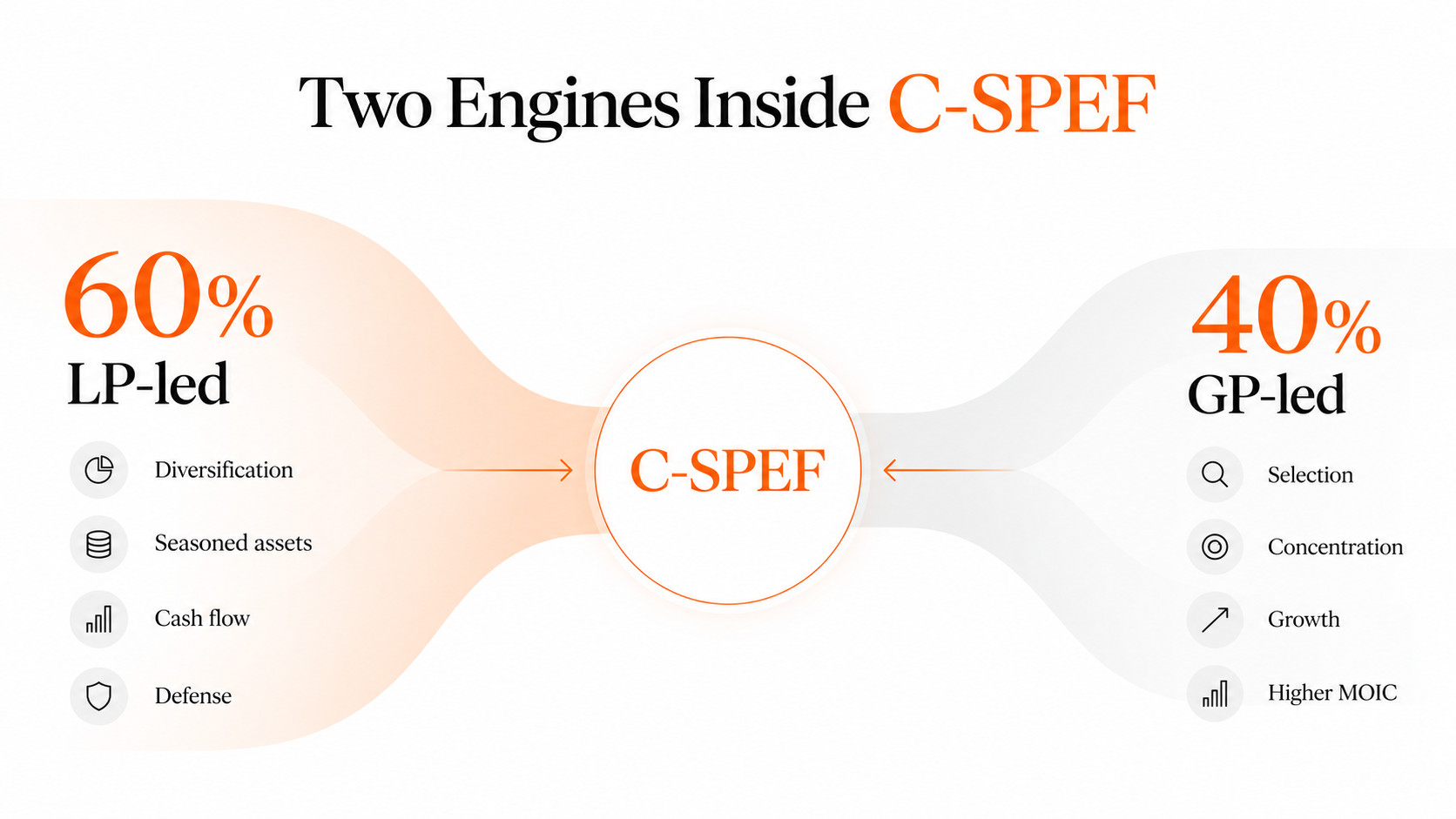
That distinction matters enormously for C-SPEF. During our diligence discussion, the manager described the portfolio as approximately 60% LP-led and 40% GP-led. The LP-led component functions as the more diversified "beta" of secondary investing, while GP-led transactions provide a more concentrated source of return uplift.
The LP-led portfolio contributes diversification across funds, managers, vintages, sectors, geographies and underlying companies. The GP-led portfolio contributes something different: greater concentration, more targeted underwriting, potentially stronger company-level growth, and higher return potential.
C-SPEF combines both. It is therefore more useful to think about C-SPEF as a portfolio architecture than as a single secondaries strategy.
Growth, not discount, is the long-term return engine
One of the most useful findings from our work with the manager concerned purchase discounts. Our original normalized assumption for LP-led transactions was approximately an 8% discount to NAV.
That assumption was validated as broadly reasonable. The manager indicated that recent LP fund-book pricing had been around 91 cents on the dollar, with high-single-digit to low-double-digit discounts broadly representative of the current market.
C-SPEF's existing portfolio, however, had been acquired at an average discount closer to 13%. That sounds important - and it is. But the next observation was much more important.
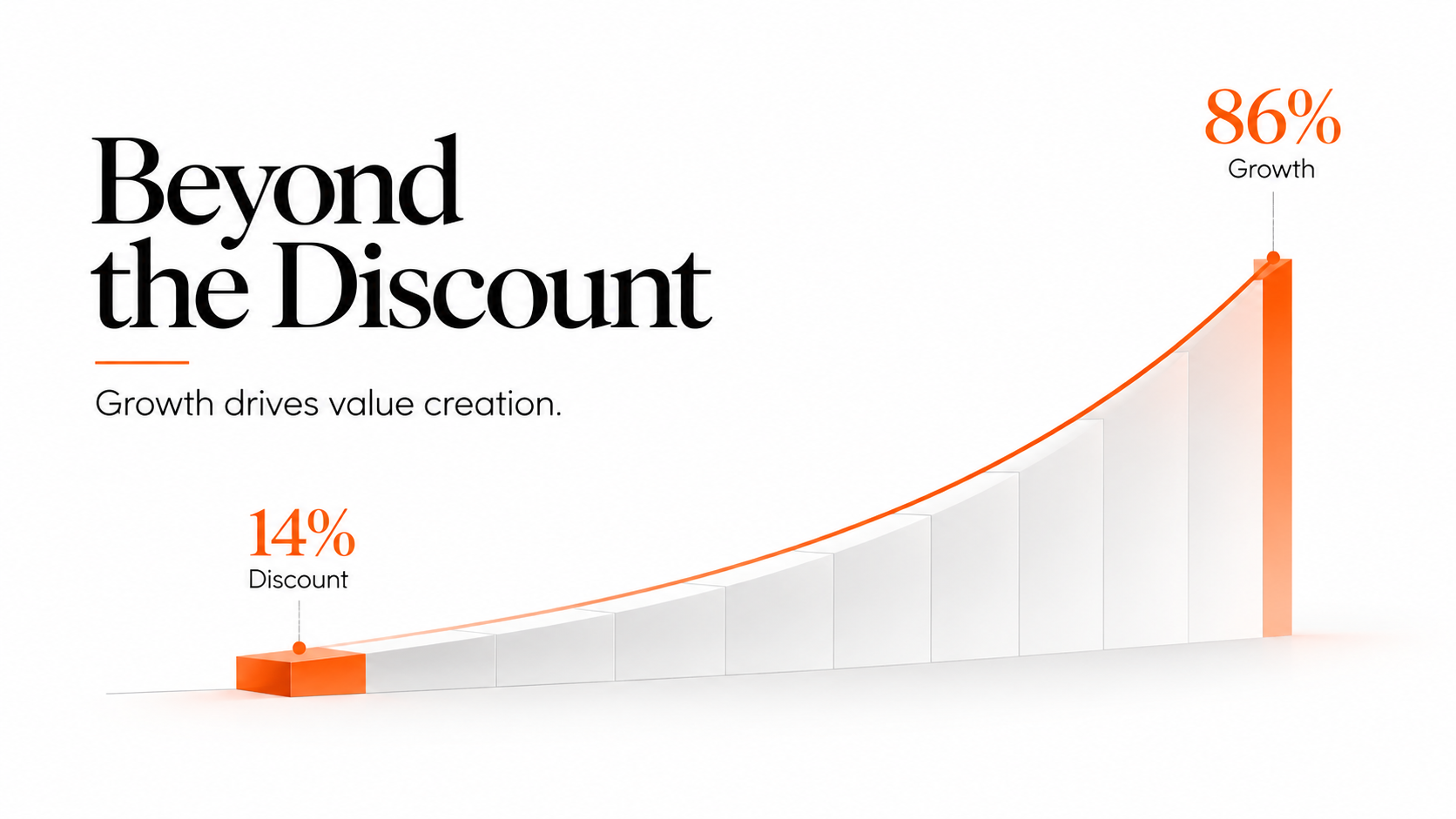
At the current stage of the fund, management described return attribution as approximately 60% growth / 40% discount. Yet on a forward underwritten basis for the current portfolio, the expected contribution shifts much more heavily toward growth: approximately 86% growth / 14% discount.
Discount capture is front-loaded. As the portfolio matures, future returns depend increasingly on underlying EBITDA growth, operating improvements, debt reduction, exit values and the quality of the businesses purchased. For advisors, that is a much more important question than whether today's average secondary-market discount is 8%, 10% or 13%.
Why buyout dominates the portfolio
That emphasis on growth helps explain another important feature of C-SPEF: its focus on buyout. The strategy is deliberately not built around venture or growth exposure.
Buyout portfolios generally offer more mature businesses, more established earnings, more observable cash flows, clearer valuation benchmarks and more predictable pathways to liquidity.
The investment process is bottom-up. The manager wants to understand the companies inside the fund interests being acquired - not simply buy diversified NAV because it happens to be available below the last reported mark.
This also explains why C-SPEF should not be confused with a classic tail-end secondaries strategy. For LP-led acquisitions, the manager indicated that typical fund books may have roughly 4.5 years of remaining life and are often acquired shortly after the underlying investment period has ended.
That is an interesting middle ground. The portfolio is seasoned enough that the underlying assets are largely known, but it is not so mature that most of the return opportunity has already been harvested. There is still time for operating growth to matter.
LP-led defense, GP-led upside
The underwriting framework reinforces the same idea. For LP-led fund books, the manager described an underwriting floor around 15% net IRR and approximately 1.5x MOIC.
GP-led transactions require different economics. Multi-asset GP-led deals may be underwritten closer to a 1.8x floor, while single-asset transactions may require economics closer to roughly 2.0x-2.1x or above, depending on the asset and sector.
LP-led: the foundation
- Broad manager and vintage diversification
- Known underlying assets and earlier cash generation
- Reduced blind-pool risk
- A more defensive secondary-market return profile
GP-led: the return accelerator
- More concentrated exposure
- Deeper company-specific underwriting
- Higher expected multiples on invested capital
- More direct exposure to operating growth and upside dispersion
The combination is the key: the LP-led book is designed to stabilize the portfolio, while the GP-led book is designed to add return.
A genuinely transatlantic portfolio
This brings us to what we believe is one of the most distinctive features of C-SPEF: geography.
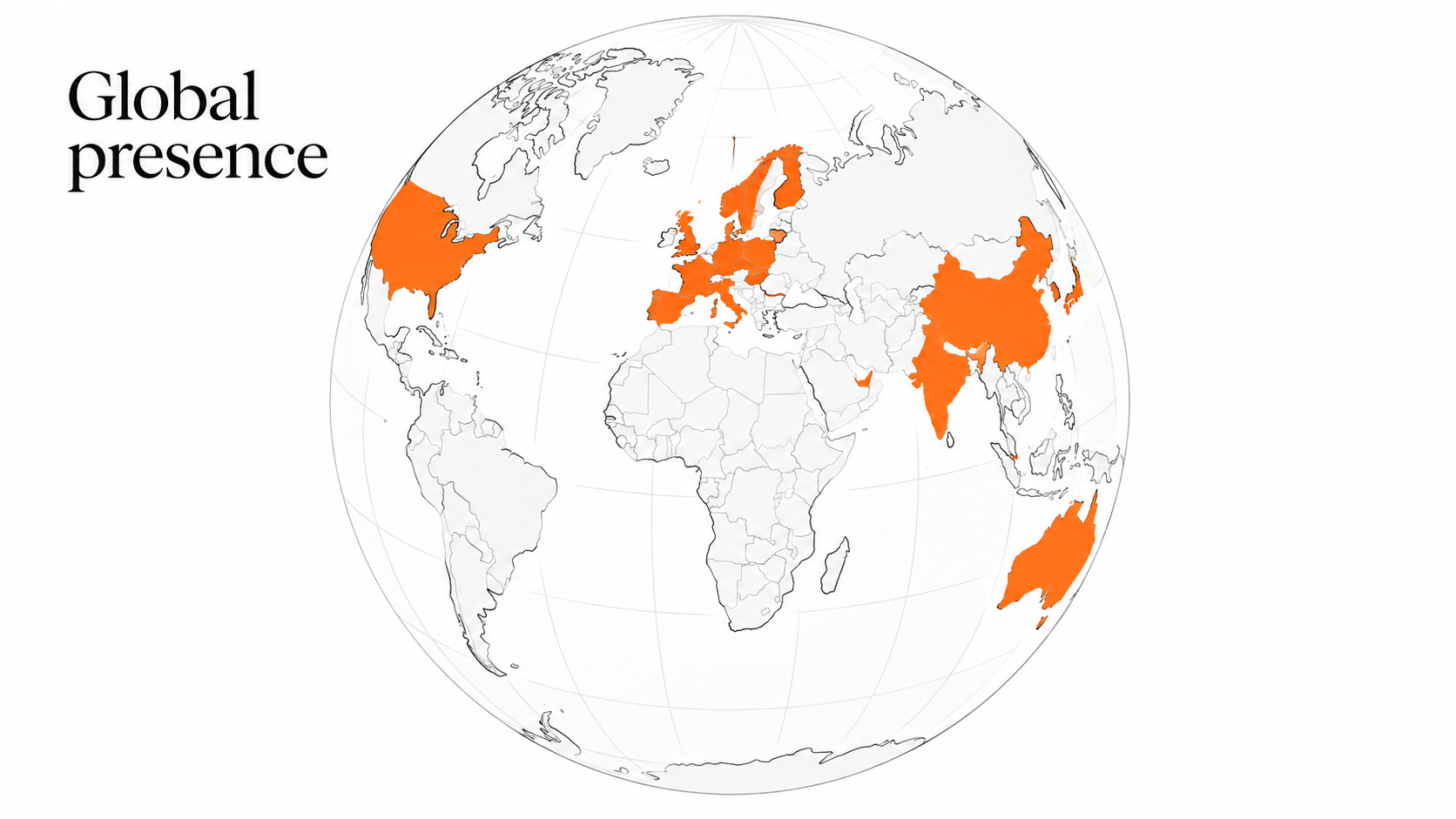
The portfolio is not simply a U.S. private-equity strategy packaged inside a global organization. The manager described C-SPEF as approximately 60% North America and 40% Western Europe and the UK, with more than 1,600 underlying companies and more than 80 private-equity managers represented across the portfolio.
North America and Europe do not move independently, of course. Private-market portfolios remain exposed to global credit conditions, interest rates, financing markets and economic cycles. But regional differences can still matter: valuation cycles, financing conditions, sector opportunities, exit environments and regulatory backdrops do not always move in lockstep.
For a U.S. advisor, C-SPEF therefore brings more than private-market exposure. It brings access to a portfolio that is materially transatlantic. That geographic character existed before EQT. The EQT combination makes it more interesting.
Coller EQT: London secondaries specialization inside a Stockholm-rooted global platform
There is an important distinction to make here. EQT AB is headquartered in Stockholm. Its registered office is in Stockholm, and the organization has deep Nordic roots alongside a global operating footprint.
Coller EQT, meanwhile, continues the London-rooted secondaries franchise with offices across North America, Europe and Asia-Pacific. The new organization effectively combines a London-rooted global secondaries specialist with a Stockholm-headquartered global private-markets platform.
That is more than a branding change. EQT now reports Secondaries as a separate business segment alongside its other private-market businesses, while Coller EQT remains one of the largest dedicated secondaries platforms globally.
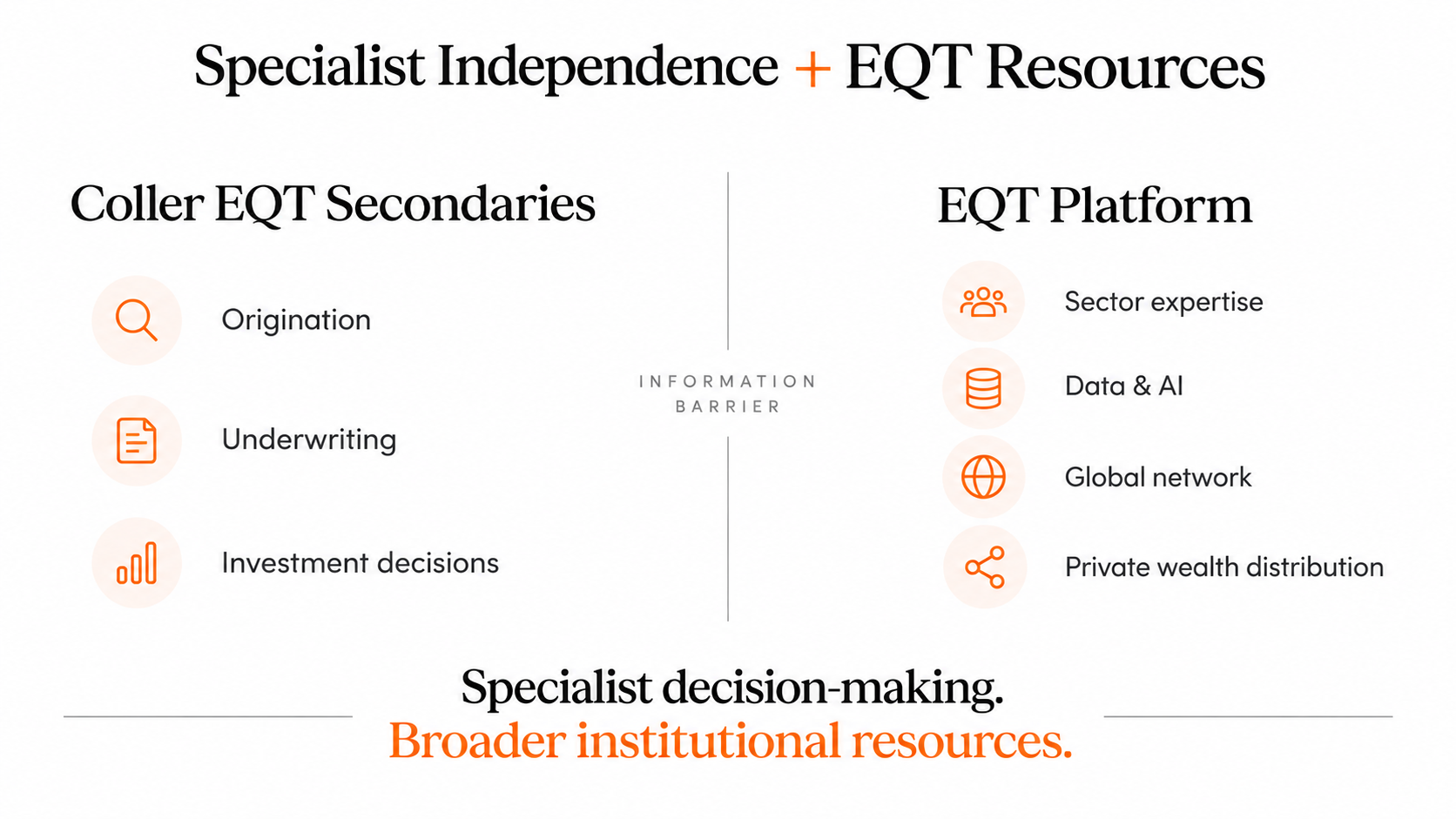
The broader platform brings substantial resources in sector research, operational value creation, global institutional relationships, private-wealth distribution, technology, data and artificial intelligence.
For us, the most interesting part is how the combination is structured. The secondaries investment process remains separately governed. Origination, underwriting and investment decisions remain within the specialist secondaries organization rather than being absorbed into EQT's traditional buyout process.
That independence matters. A secondaries buyer often acquires assets from managers with whom its broader organization may have commercial relationships. Maintaining information barriers and an independent investment process is central to protecting the credibility of the underwriting process.
The potential advantage is not that C-SPEF becomes a captive buyer of EQT assets. The more interesting possibility is that specialist secondaries decision-making remains intact while the team gains access to the resources of a much larger global private-markets organization.
Global sourcing matters more than the logo
It would be a mistake, however, to attribute C-SPEF's global character only to the EQT transaction. Coller was already a global secondaries specialist.
The manager operates a large dedicated secondaries investment team and emphasizes direct origination rather than relying only on broadly intermediated auction processes. During our diligence process, the team described a very wide sourcing funnel and indicated that only about 2% of opportunities screened are ultimately completed.
We would never translate a 2% selection rate directly into a return premium. But it tells us something important: the objective is not to own a representative sample of the secondaries market. The objective is to own a highly selected subset of it.
That sourcing discipline becomes more important as secondaries become more competitive. More capital is entering the market, more buyers are bidding for high-quality assets, and headline discounts alone are becoming less useful as a measure of opportunity. In that environment, sourcing itself becomes part of underwriting.
One investment process across institutional and private-wealth vehicles
There is another subtle feature of the Coller model that matters for C-SPEF. The U.S. perpetual fund does not operate as a separate private-wealth investment strategy with completely different underwriting.
The manager explained that the same investment organization evaluates transactions for its flagship institutional fund and perpetual vehicles, with approved opportunities allocated through a formal allocation process across the relevant vehicles.
That is particularly important because C-SPEF itself has a relatively short standalone operating history. The investment process behind it does not. For research purposes, this provides a stronger rationale for studying the broader Coller track record, cash-flow history and underwriting philosophy when evaluating C-SPEF. The wrapper is newer. The underlying secondaries process is not.
Why secondaries fit an evergreen structure
Evergreen private-market funds face a basic structural problem. Investors want some degree of liquidity. Private assets themselves are illiquid.
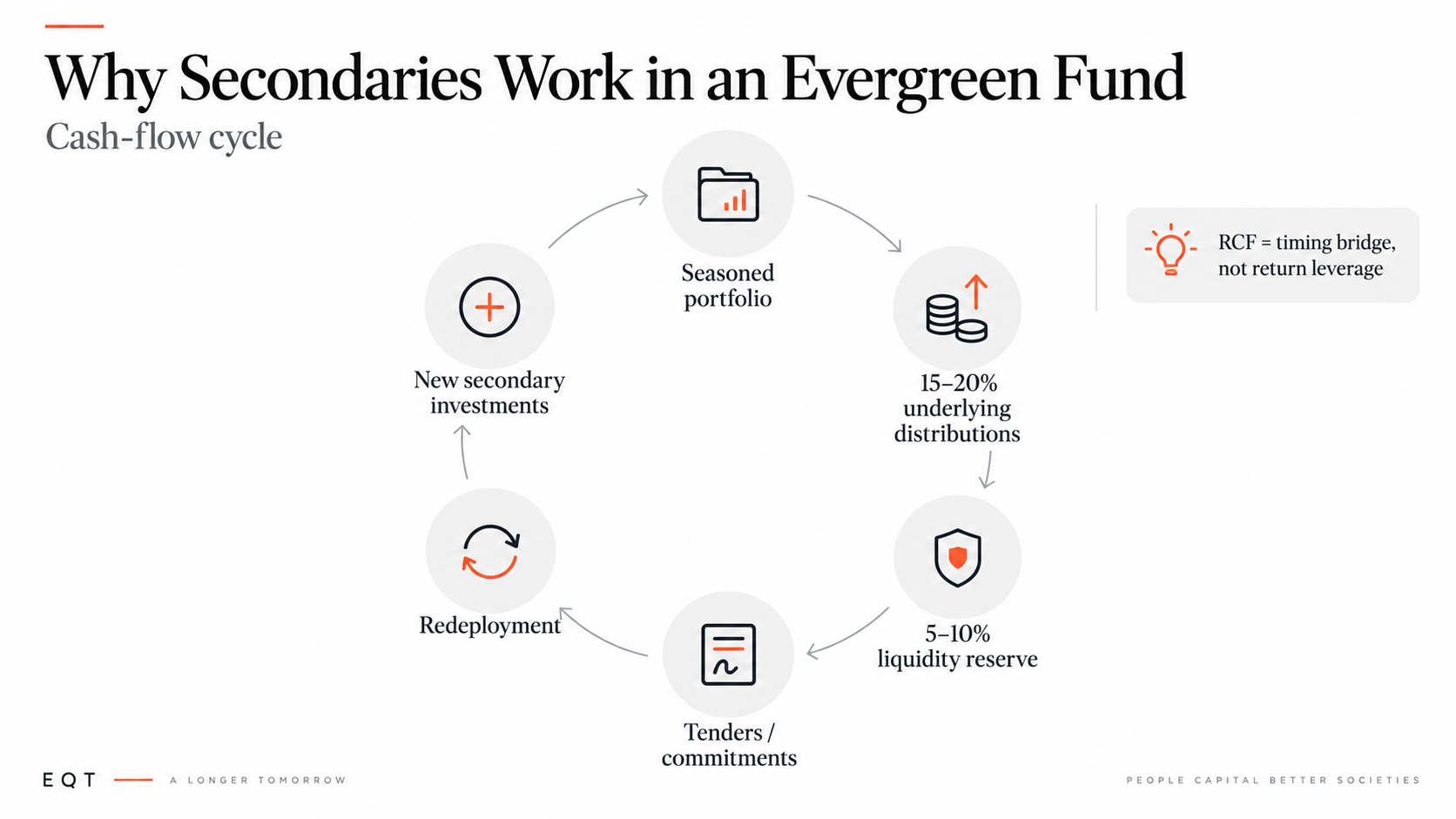
The portfolio therefore has to continuously balance new subscriptions, underlying distributions, tender requests, capital calls, unfunded commitments, new acquisitions and liquidity reserves.
Secondaries have a natural advantage here. They are seasoned assets. And seasoned assets generate cash.
The manager indicated that diversified buyout portfolios historically generated roughly 20%-30% annual underlying distributions. In today's lower-DPI environment, that figure has been closer to 15%-20%.
C-SPEF also maintains approximately 5%-10% cash to help manage tender activity, unfunded commitments, transaction timing and deferred acquisition obligations.
Cash is not simply an idle drag. It is an operating tool. But too much cash does become expensive, which is why deployment speed matters. LP-led transactions often close at quarter-end, while GP-led transactions may close intra-quarter. That gives the portfolio different ways to put capital to work depending on the opportunity set.
The quarterly tender mechanism is also important. C-SPEF may offer to repurchase up to approximately 5% of fund NAV in a quarterly tender, subject to the Board and the terms of the offer. That mechanism helps manage liquidity, but it does not turn an illiquid private-market investment into a daily redeemable product.
Fees: one of the easiest places to get the model wrong
Private-market fee analysis gets complicated quickly. The underlying private-equity funds charge their own management fees and carried interest. C-SPEF then has its own fund-level fees and expenses.
A naive model can easily deduct both layers twice. The manager confirmed that underlying fund expenses and accrued carry are already reflected in the underlying NAV and performance received by C-SPEF.
That may sound like a technical accounting issue. It is not. An extra 1% or 2% annual deduction compounded over ten years can completely distort the expected outcome of a private-markets investment.
How does C-SPEF change a traditional portfolio?
This is where our research process differs from a standard fund review. We are less interested in asking whether C-SPEF is attractive in isolation. We are more interested in asking what happens when it is inserted into an advisor client's existing portfolio.
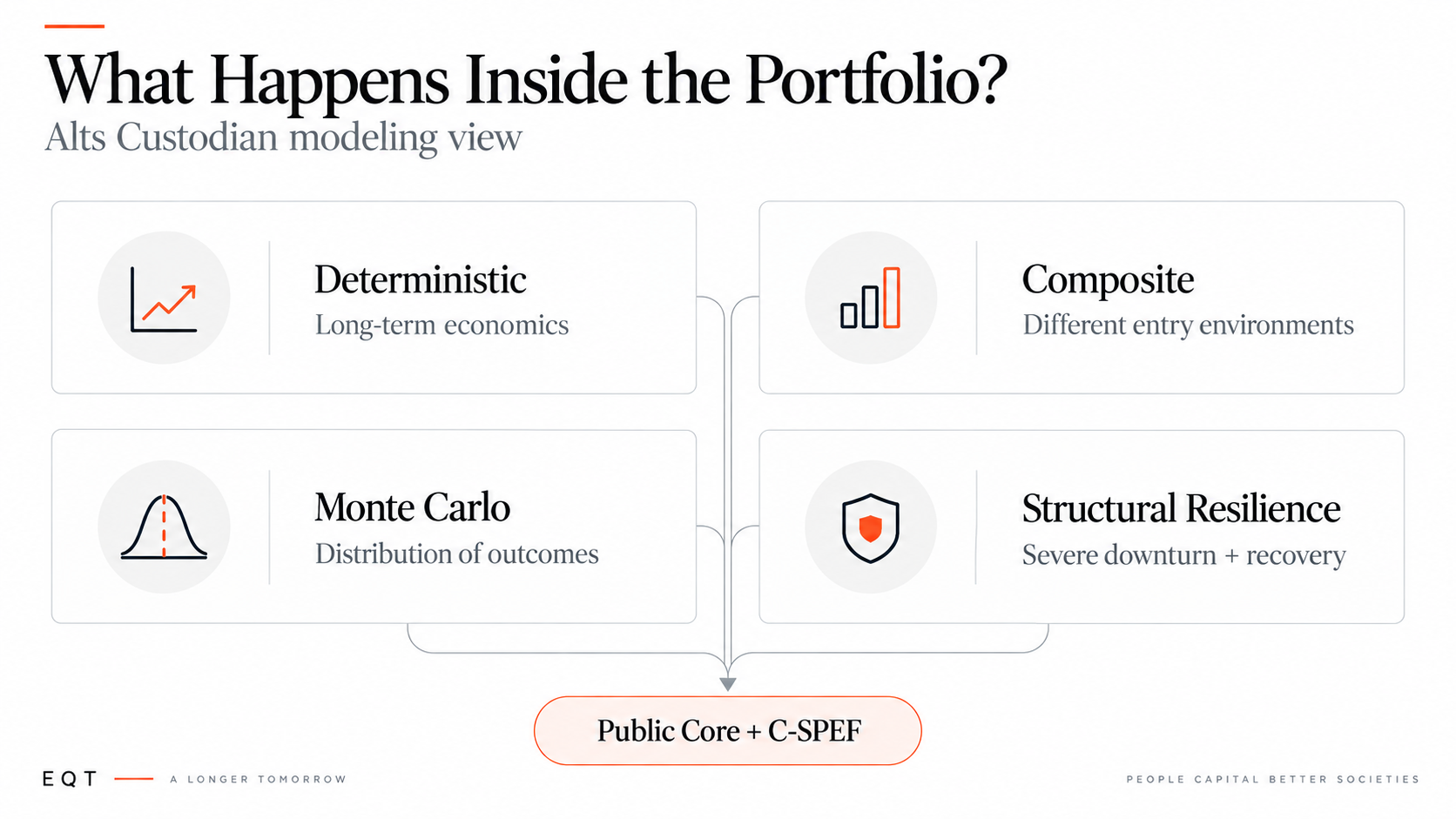
Our portfolio model begins with a traditional public-market Core and then evaluates how allocating part of that portfolio to C-SPEF changes the outcome.
Deterministic
What happens if normalized long-term economic assumptions broadly hold?
Composite Entry-Path
What happens if the investor enters during different economic regimes - Expansion, Inflation, Recession, Recovery or Stress?
Monte Carlo
Across a large set of paired public and private market paths, how often does the integrated portfolio outperform Core, and what happens to the left and right tails of the distribution?
Structural Resilience
What happens during a prolonged economic downturn followed by recovery?
The answers are not identical, and they should not be. A private fund should not be selected because one number looks better than another fund's number. It should be evaluated in terms of the role it plays inside the total portfolio.
What our current model says
Using our current normalized lifecycle assumptions for C-SPEF, the modeled long-term return is approximately 13.7%.
With a 20% allocation to C-SPEF, the deterministic portfolio result improves materially relative to the public Core. But the more interesting results come when uncertainty is introduced.
Under our Composite Entry-Path analysis, the integrated portfolio continues to improve long-term expected wealth even after different macroeconomic entry conditions are considered.
In our current Monte Carlo implementation, C-SPEF raises the median outcome and materially improves the downside tail, while giving up some exposure to the most extreme public-equity upside scenarios.
At a 20% C-SPEF allocation in our current 100,000-path model, the probability of a negative ten-year portfolio return falls materially relative to Core, the 5th-percentile outcome improves sharply, and the integrated portfolio beats its paired Core path in roughly 73% of simulated outcomes.
That does not mean C-SPEF wins in every environment. It does not. In fact, the highest public-equity outcomes can outperform the integrated portfolio because allocating to C-SPEF necessarily means owning less public equity.
That trade-off is precisely what portfolio construction is supposed to reveal.
Stress is where diversification has to prove itself
Expected returns are easy to discuss when markets cooperate. The more difficult question is what happens when they do not.
Our representative severe-stress analysis does not assume that private assets magically avoid economic losses simply because their reported NAVs update more slowly. We model economic value separately from reported NAV.
In our current severe case, C-SPEF experiences a meaningful economic decline. The integrated portfolio still benefits because the diversified secondaries sleeve loses somewhat less at the total-portfolio level and recovers faster than the public Core.
At a 20% C-SPEF allocation, our current structural model produces a slightly shallower maximum portfolio drawdown, a faster recovery to the prior portfolio peak, and a materially higher ending portfolio value after the modeled ten-year stress-and-recovery cycle.
The reason is not that C-SPEF avoids the downturn. It does not. The reason is that its cash-flow profile, seasoned holdings, LP-led diversification and post-trough recovery economics behave differently from the public portfolio.
That is the diversification benefit we care about.
Three secondaries funds, three very different stories
This is now the third secondaries strategy we have examined in depth. What has been most interesting is that all three ultimately tell a different story.
Pomona: the pioneer
Pomona's story is about pioneering private-equity access for private wealth and solving one of the industry's most persistent challenges: how to build an evergreen private-equity portfolio while managing liquidity.
Its long operating history gives investors a real-world example of what happens when secondary exposure is continuously recycled inside a private-wealth structure.
StepStone: the scale advantage
StepStone's differentiation is different. Its extraordinary breadth across private markets creates a large information, sourcing and underwriting network that can be reused across strategies and vehicles.
Its advantage is not simply fund size. It is the ability to leverage a very large investment platform across multiple parts of the private-market ecosystem.
Coller EQT: specialization meets global reach
C-SPEF presents a third model. Its roots are in a specialist secondaries organization built in London. Its portfolio is materially transatlantic. Its return engine combines diversified LP-led exposure with more targeted GP-led investments.
And now the specialist business sits inside EQT, a Stockholm-headquartered global private-markets organization with deep sector, geographic and operating resources.
A globally sourced portfolio, underwritten through a secondaries-specific process, with a meaningful European footprint and access to the resources of a much broader global private-markets organization.
Beyond the discount
The secondaries market is still frequently described through discount-to-NAV. That is understandable. Buying something for 90 cents that was previously marked at a dollar is intuitive.
But as the market becomes larger and more competitive, that explanation becomes less useful.
The more important questions are:
- What assets are being purchased?
- How much growth remains?
- How concentrated are the positions?
- How much cash does the portfolio naturally generate?
- How selective is the manager?
- How globally diversified is the opportunity set?
- And what happens when the next downturn arrives?
For C-SPEF, our research increasingly points toward a strategy built around known assets, go-forward growth, LP-led diversification, GP-led upside, global sourcing and disciplined portfolio construction.
The combination with EQT adds another layer. Coller EQT now sits at the intersection of specialist secondaries underwriting, European and North American private markets, institutional sector expertise, global sourcing, technology and data infrastructure, and expanding private-wealth access.
None of those attributes guarantee future returns. But together they make the Coller Secondaries Private Equity Opportunities Fund one of the more differentiated secondaries offerings for advisors to understand.
And from our perspective, that is the broader lesson from this third secondaries study.
Selected sources and research notes
EQT, "EQT closes combination with Coller Capital," August 31, 2026. https://eqtgroup.com/news/eqt-closes-combination-with-coller-capital-2026-08-31
Coller Secondaries Private Equity Opportunities Fund (C-SPEF), fund website and 2026 fund documents. https://cspef.com/
EQT, corporate information and global office footprint. https://eqtgroup.com/about
Management discussion with Coller EQT, August 2026. Portfolio construction, underwriting, discounts, cash-flow behavior, liquidity and vehicle mechanics discussed in this article reflect manager commentary provided during Alts Custodian's due-diligence process.
Alts Custodian portfolio modeling. Deterministic, Composite Entry-Path, Monte Carlo and Structural Resilience figures are model outputs based on current governed assumptions and are illustrative, not forecasts.
Important disclosure
This material is for informational and educational purposes only. It is not investment advice, a recommendation, an offer to sell or a solicitation to buy any security. Private investments involve substantial risk, limited liquidity and the potential loss of capital. Model results depend on assumptions and may differ materially from actual outcomes.