

An advisor can buy a stock in seconds. Investing alongside the people who buy and build private businesses can take a relationship, a substantial commitment and years of patience.
The appeal of a smaller private-equity firm is often easy to understand. A focused team can know its market intimately and move quickly when an opportunity appears. Access can be harder to arrange. An advisor may see the attraction of that investment approach without having a practical way to bring clients into the partnership.
My conversation with Partners Group brought those two questions together. What stood out was private equity at scale: the detailed work of evaluating companies and helping them grow, supported by a global investment organization.
The firm’s capabilities extend from direct ownership to investments in other private portfolios. Through Partners Group Growth, LLC, or GROW, eligible individual investors can participate in that work through an evergreen fund.
That combination is what makes GROW interesting to me. An advisor can evaluate the firm as a business owner and investment partner, then ask how its capabilities translate into a client’s portfolio. The story begins with what happens inside the companies, where the eventual investment return has to be earned.
The investment business behind the fund
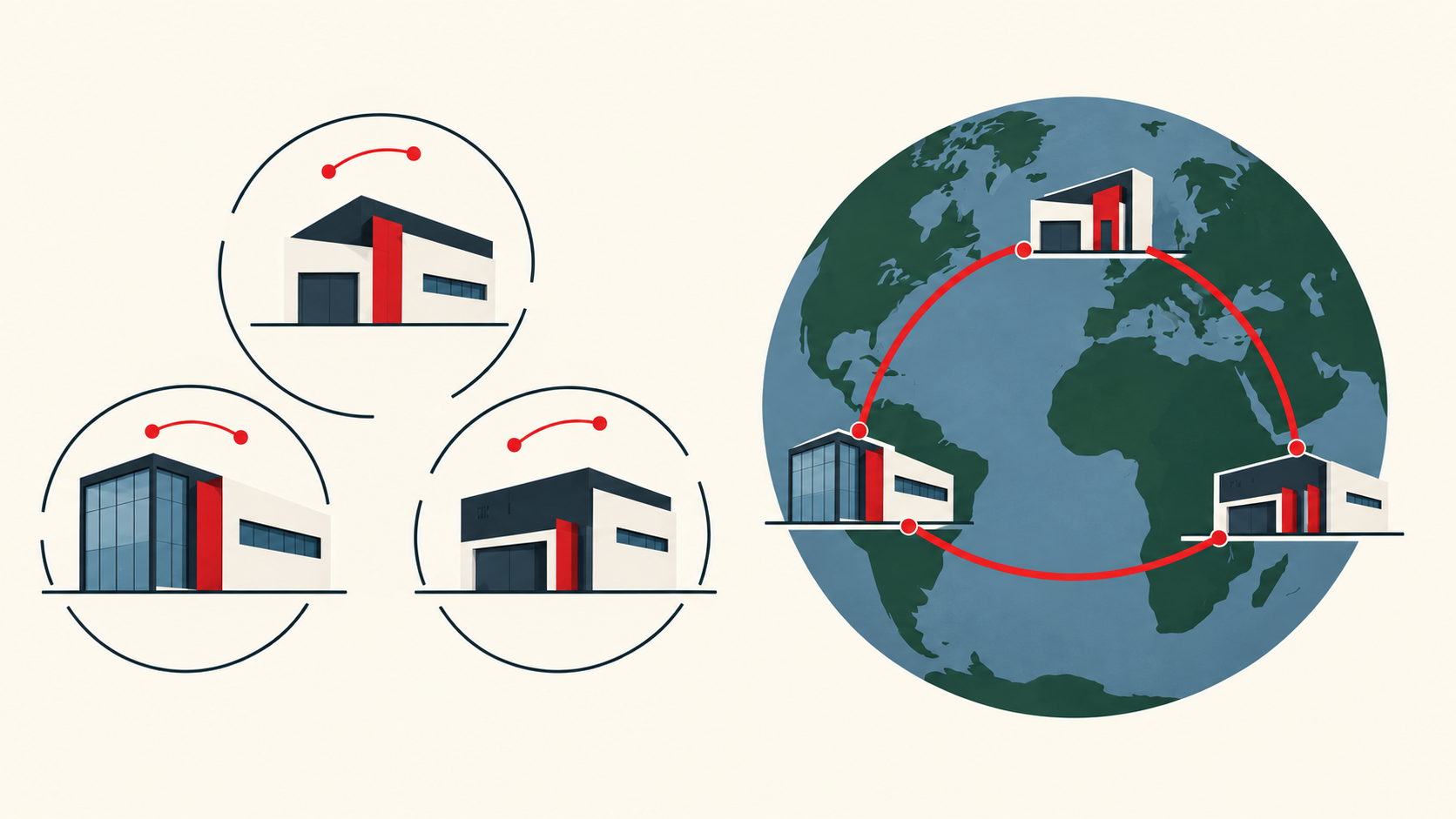
Partners Group managed $186 billion across its global private-markets business at June 30, 2026. Its investment organization includes more than 500 investment professionals and a network of over 200 operating directors and industry advisers. These are firm-wide resources across several asset classes, rather than the size or dedicated staffing of GROW. They give substance to the idea of private equity at scale: substantial capacity for evaluating investments and working with businesses after the investment closes. [1, 2]
One transaction makes that capacity easier to picture. In July 2024, Partners Group announced an agreement to acquire a majority stake in FairJourney Biologics, a Porto-based antibody-discovery business, on behalf of its clients. Founder António Parada would remain a significant shareholder. The stated plan included expanding the company’s capabilities through organic growth and acquisitions. [3]
For an investor, the appeal of that kind of transaction is tangible. A company has scientific expertise and customers; an owner supplies capital, governance and a plan for expansion. The eventual outcome depends on execution, competition and the purchase price. There is a business to understand before there is a return to project. FairJourney illustrates Partners Group’s ownership approach; it is not evidence that every GROW investment carries the same control rights or follows the same plan.
The connection between that operating business and different investor channels is especially interesting. In 2024, Partners Group said its fifth direct private-equity program had exceeded a $15 billion fundraising target. The program combined a flagship fund with bespoke client solutions and allocations from open-ended vehicles investing in the same direct-equity strategy. That was a program total, not the size of a single fund. [4]
This helps explain the attraction of Partners Group for an advisor. The firm can bring an established investment organization to clients with very different ways of investing. GROW offers one route into those capabilities, subject to its own mandate and allocation rules. Participation through an evergreen fund does not give every investor identical deals or economics.
What the investor actually owns
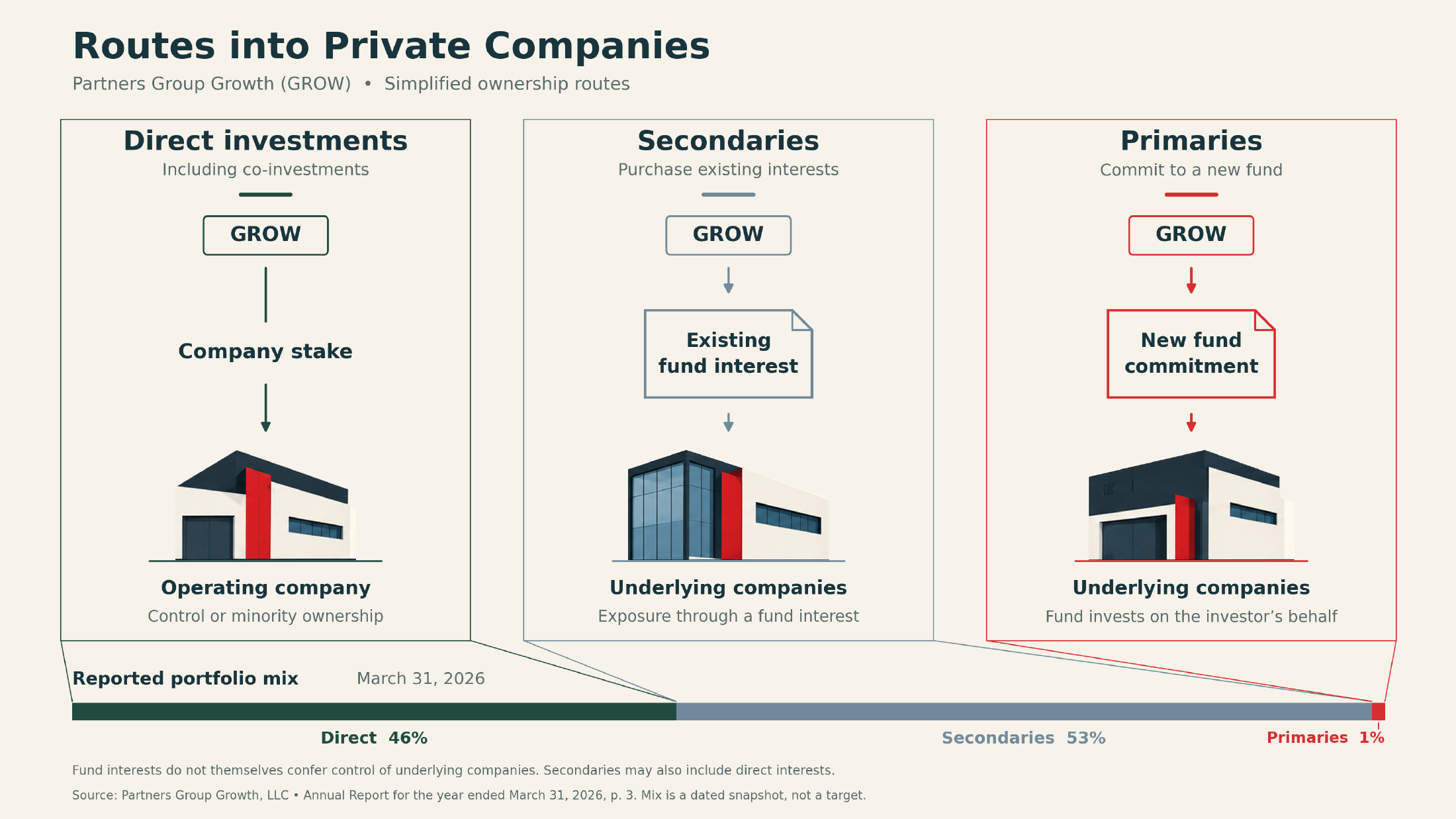
GROW combines several routes into private companies. Its audited report showed a portfolio allocation of 46% direct investments, 53% secondaries and 1% primaries at March 31, 2026. The report described exposure to more than 1,000 underlying companies across more than 16 vintage years. Those figures describe a dated portfolio snapshot, rather than permanent allocation targets. [5]
The distinctions matter. A direct investment can put capital into a company, sometimes alongside another lead investor. A secondary purchase acquires an existing investment interest from a previous owner. A primary commitment backs a fund that will build and manage its own portfolio. Each route brings a different combination of control, information, timing and costs.
Secondaries can provide access to portfolios that already contain operating companies, giving the buyer more to examine than an entirely unbuilt portfolio. They can also shorten the remaining wait for some realizations. Neither advantage makes the purchase automatically attractive: the price, the underlying assets and the time required to sell them still matter.
Describing GROW simply as a collection of Partners Group buyouts would therefore miss much of the investment. The fund combines direct investing with the evaluation and acquisition of interests in other private portfolios. The ownership rights and the path to realizing value depend on the route taken.
Partners Group also has a longer history in evergreen structures than the current surge of advisor interest might suggest. The firm dates its first evergreen program to 2001 and its first US 1940 Act evergreen private-equity offering to 2009. GROW itself is much newer. Experience running a structure is relevant, but it cannot give a new fund a longer performance record. [6]
Nor is Partners Group alone in connecting institutional private equity with private wealth. Blackstone’s BXPE offers eligible individuals access across its private-equity strategies. KKR’s K-PRIME provides an evergreen route to its platform, with availability and eligibility depending on jurisdiction. StepStone’s SPRING emphasizes venture and growth investments through a broader manager network. These are different approaches and are not interchangeable products. [7, 8, 9]
For an advisor, the comparison comes down to whose investment decisions the client will own, through which transactions and on what terms. Partners Group brings together direct ownership, secondary investing and experience managing evergreen portfolios. That combination gives the firm a distinct investment proposition within an increasingly competitive market.
From business performance to investor returns
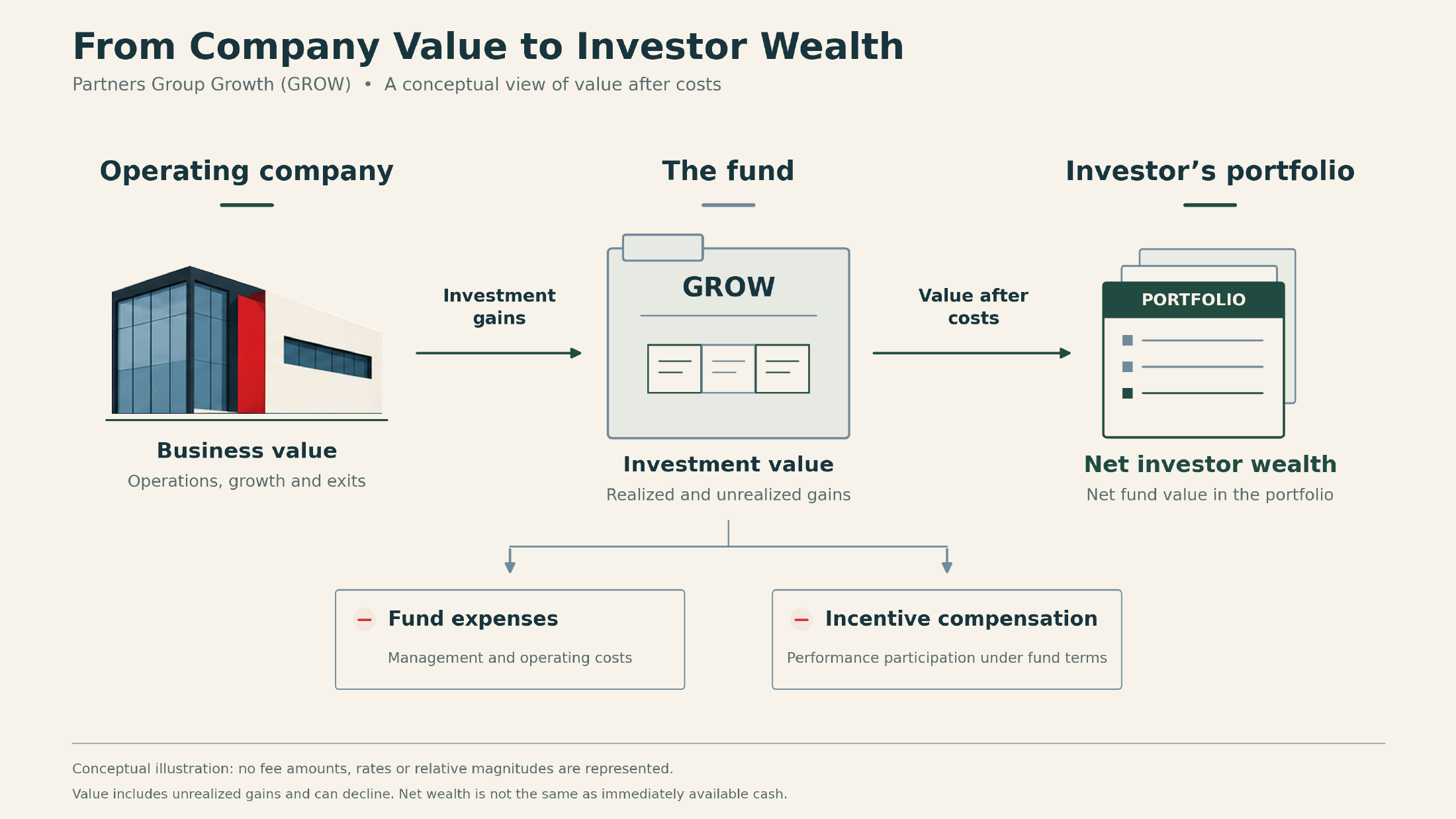
A successful investment still has to travel through the fund’s economics before it reaches the client. Management costs and incentive compensation affect how much of the value created ultimately belongs to investors.
GROW’s 15% incentive fee applies to quarterly net profits above its fund-level loss-recovery balance. Profits include unrealized appreciation and exclude subscriptions and withdrawals. The fee therefore measures eligible gains, rather than taking 15% of NAV itself. Loss recovery provides protection against charging incentive fees again while prior fund losses remain unrecovered. [5]
This approach also appears in comparable evergreen funds. StepStone’s SPRING accrues a 15% incentive fee on profits that include unrealized gains, subject to loss recovery, and pays it annually. BXPE uses a 12.5% performance allocation with a 5% annual hurdle, a high-water mark and a catch-up provision. NAV-based compensation is an established feature of this market; the detailed terms differ. [13, 14]
For investors, the relevant question is the net result over the holding period. Fees can arise before a sale, and GROW’s loss-recovery mechanism restricts future fees without automatically refunding fees already paid if valuations later fall. Our portfolio analysis includes fund costs once, so the comparison reflects modeled investor returns after those costs. [10, 12]
Matching access to the investment horizon
Evergreen funds change the investor’s experience of entering private equity. GROW accepts subscriptions into an existing portfolio, and its offering terms provide for possible repurchases rather than an investor’s unconditional right to redeem. Eligibility requirements also remain: access is for qualifying investors, not every retail brokerage account. [10]
The underlying companies still operate on business time. Expanding a laboratory or integrating an acquisition takes longer than processing a fund subscription. An advisor needs to reconcile those two clocks before deciding how much a client can comfortably allocate.
There is a recent example within the broader Partners Group business. In June 2026, its Global Value SICAV received quarterly redemption requests equal to 9.8% of NAV and applied a 5% quarterly limit. That was a different fund, not GROW. It nevertheless illustrates what a repurchase limit can mean in practice: an investor’s desired withdrawal and the amount available that quarter may differ. [11]
That distinction belongs in portfolio construction. An account statement can show wealth that is not immediately spendable. A client funding near-term expenses needs resources outside an illiquid allocation, even when the underlying investments appear attractive. A model that reports only terminal NAV misses this part of the investor’s experience.
Testing a 20 percent allocation
Our research brings these questions into a hypothetical $1 million portfolio, initially invested 20% in GROW and 80% in a public-market core. The core itself holds 80% equities and 20% bonds. The study follows a ten-year buy-and-hold period, allowing weights to drift. These are normalized Class I economics: a $200,000 fund allocation requires a confirmed waiver or aggregation arrangement to meet the documented $1 million Class I subscription minimum. [12]
The central scenario produces an annualized net return of about 13.4% for the GROW sleeve. Over ten years, the combined portfolio reaches roughly $2.5 million, compared with about $2.2 million for Core alone, a modeled advantage of around $260,000. These rounded figures illustrate the scale of the result under the study’s assumptions; they are not a forecast of the fund’s returns. [12]
The size of that difference is worth examining, but a single ending value leaves much of the investment experience unexplained. Private-company returns vary, exits take time, and assets held to meet obligations can change in value. We therefore also examine a range of market paths and more demanding funding conditions.
The model distinguishes cash from credit investments held for liquidity. Credit can provide income, but a sale may take time and deliver less cash during the same downturn that slows private-company exits. That distinction matters to the ability to hold investments through a difficult period.
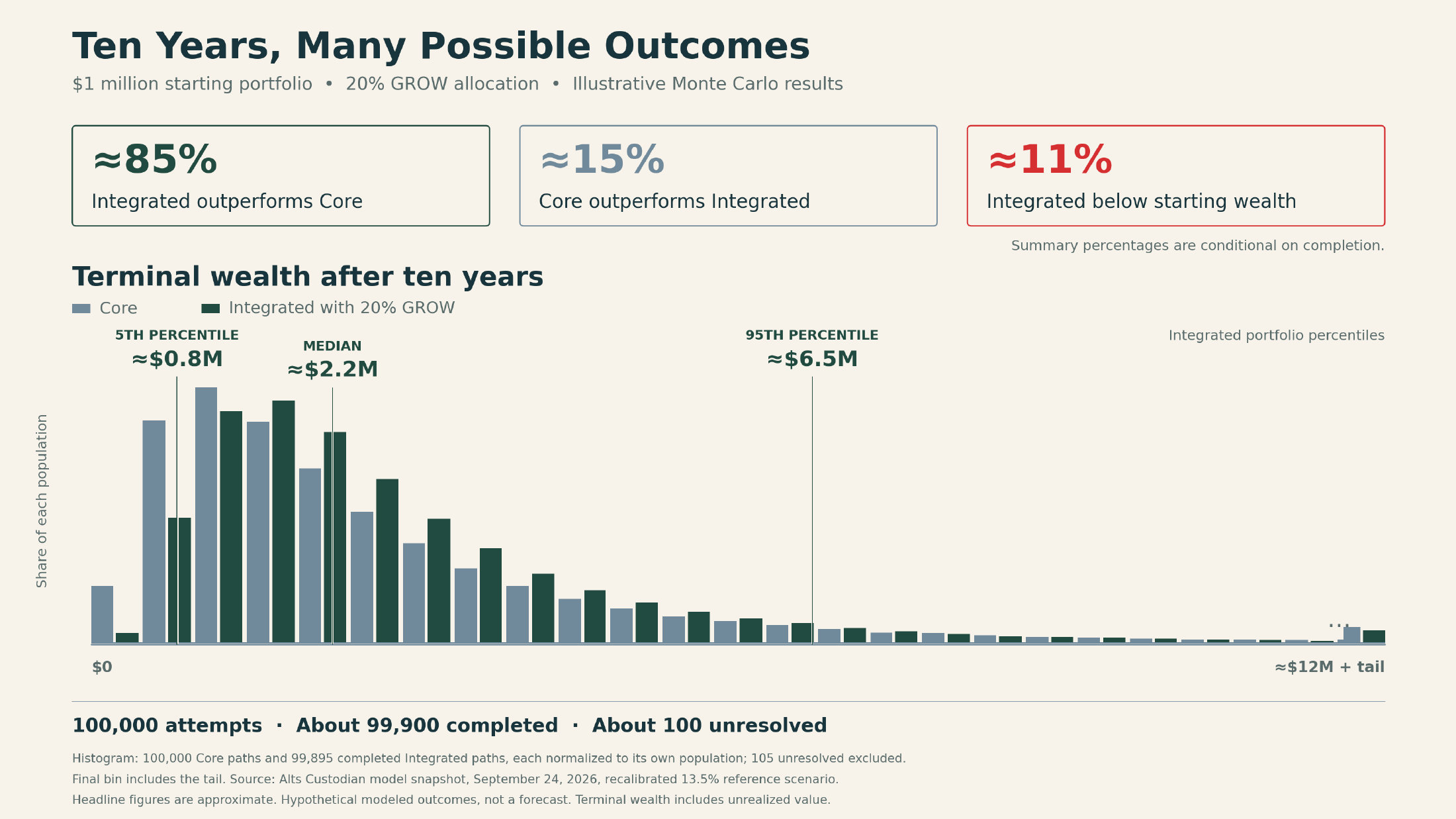
Across 100,000 matched Monte Carlo paths, approximately 99.9% complete, with about 100 unresolved because the model cannot meet its funding requirements. The combined portfolio finishes ahead of Core in roughly 85% of completed pairs. This is an illustrative result within the assumed model, conditional on completion, rather than an observed probability of future outperformance. [12]
The distribution also shows why a favorable comparison with Core is only part of the decision. Median combined wealth is around $2.2 million, but roughly 11% of completed paths finish below the original $1 million. The accompanying illustration places the 5th and 95th percentiles at about $0.8 million and $6.5 million. An allocation can improve relative results while still exposing the client to losses. [12]
The conclusion is sensitive to the assumptions. In separate volatility tests, the share of completed paths beating Core ranges from roughly 82% to 89%, with different numbers of unresolved paths. Those results make volatility and the relationship between public and private returns central to the analysis. [12]
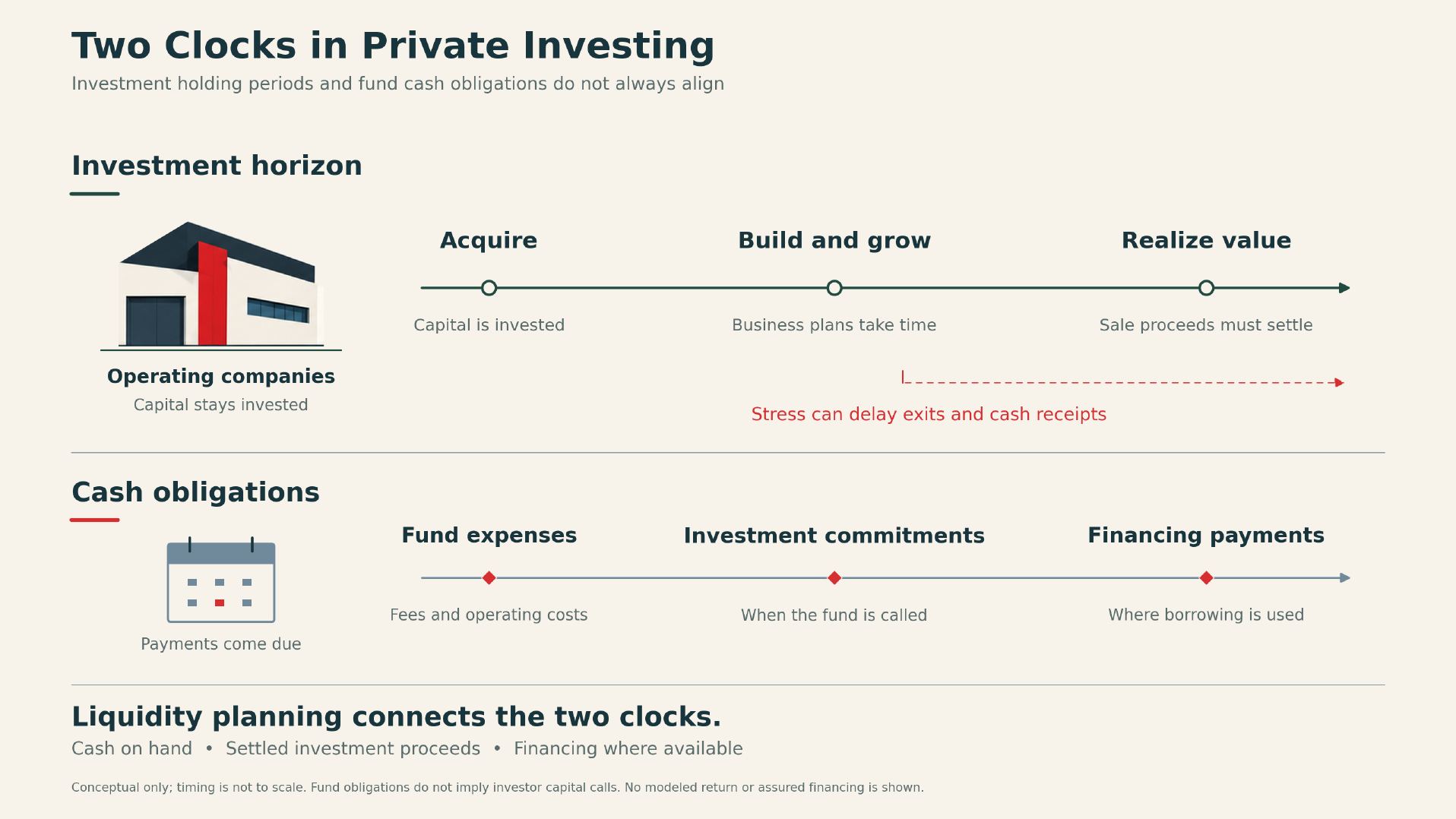
The combined structural downturn is more demanding. In the September 24 scenario that permits no new borrowing or facility renewal, the model encounters a funding shortfall before year ten. A separate sensitivity allowing borrowing and renewal remains feasible in that same combined scenario. These results identify a dependence on financing assumptions; they do not establish that GROW will experience a shortfall or that financing will always be available. [12]
For an advisor, the practical question is whether the fund and the client can remain invested long enough for the underlying businesses to deliver. The stress assumptions remain under review, including settlement timing, existing obligations and investment realization schedules. The numerical findings should remain provisional until that work is complete. [12]
The decision behind the allocation
What stayed with me after the conversation was the connection between a client’s allocation and the work of owning businesses. Partners Group has the resources to pursue that work on a large scale. GROW gives eligible investors a way to participate through a portfolio that combines direct investments with secondaries and primaries.
The 20% study gives that idea a portfolio context. Its central assumptions produce a meaningful increase in modeled ending wealth, while the wider distribution shows substantial variation and the possibility of loss. The fund’s appeal deserves to be assessed through both its investment capabilities and the terms on which clients can use them.
A business may need years to expand into a new market or complete an acquisition. The investor has to be able to give it that time. For an advisor with a suitable client, the interesting possibility is access to an organization capable of doing that work, through a structure the client can own. That is the promise of private equity at scale, and the proposition GROW puts in front of us.
Sources and publication notes
Editorial and peer-fee review: September 28, 2026. Model results: September 24, 2026. Portfolio snapshots retain their stated dates. Results are provisional and not independently validated. Terminal wealth is marked NAV, not immediately withdrawable cash. Credit behavior, settlement timing, cohort data, opening accounts and Class I access require confirmation before publication of definitive model conclusions. Investor taxes and external advisory costs must be identified in the final methodology. This educational analysis is not an offer or individualized investment recommendation.
- Partners Group half year results announcement, September 1, 2026. Firm-wide AUM at June 30, 2026. Source 1 ↗
- Partners Group Our Approach. Investment professionals and operating network. Source 2 ↗
- Partners Group FairJourney Biologics majority investment announcement, July 1, 2024. Source 3 ↗
- Partners Group fifth direct private equity program fundraising announcement, 2024. Source 4 ↗
- Partners Group Growth audited annual report for the year ended March 31, 2026. Allocation snapshot and incentive fee accounting. Source 5 ↗
- Partners Group Our Heritage. Evergreen history. Source 6 ↗
- Blackstone BXPE official fund website. Source 7 ↗
- KKR K PRIME official fund website. Availability differs by jurisdiction. Source 8 ↗
- StepStone SPRING official fund website. Source 9 ↗
- GROW public offering disclosures, SEC Form N 2 filed February 27, 2024. Structural and risk disclosures, cross-checked against supplied July 2024 terms. Confirm current eligibility and subscription terms before publication. Source 10 ↗
- Partners Group evergreen funds update, June 4, 2026. Global Value SICAV liquidity example; this is not GROW. Source 11 ↗
- Alts Custodian research report on the Partners Group GROW manager update, September 24, 2026, including supplied comparisons, sensitivity results and assumptions notes. Model figures in the narrative are rounded illustrations based on the fixed-input scenario; Illustration 4 uses the separately recalibrated 13.5% reference scenario. Its Core histogram includes all 100,000 paths and its Integrated histogram includes 99,895 completed paths, each normalized separately. The paired win rate is conditional on completion. Figures may change as the model develops. Outputs were supplied and have not been independently rerun for this article. Unresolved paths and funding shortfalls are model outcomes, not observed fund default probabilities.
- StepStone Private Venture and Growth Fund annual report for the year ended March 31, 2026, Note 5. Incentive fee rate, unrealized gains, loss recovery and payment timing. Source 13 ↗
- Blackstone Private Equity Strategies Fund quarterly report for June 30, 2026. Performance participation allocation, hurdle, high-water mark and catch-up provisions. Source 14 ↗