

Evergreen private equity is entering a more mature phase.
Advisor demand for alternatives remains strong. In a July 2026 survey, 95% of responding advisors said they use alternatives in client portfolios, and 61% said they use evergreen or interval structures across many client accounts. At the same time, 61% identified liquidity as the leading barrier to broader implementation.
That combination captures the current market well.
Investors and advisors still want private-market exposure. But they are increasingly focused on liquidity, portfolio rebalancing, manager selection, and how semi-liquid structures behave through different market environments.
Competition has also increased. More managers now offer evergreen private-market vehicles, so new subscriptions are being distributed across a much broader universe of products than they were when some of the earliest funds were launched.
For an established platform such as Pomona Investment Fund, this creates a different operating environment: more choice for advisors, more active use of tender features, and greater importance placed on how effectively a mature fund manages liquidity while continuing to deploy capital.
That is what makes Pomona particularly interesting today.
Pomona Capital was founded in 1994 and describes itself as one of the earliest private-equity firms focused on secondaries. Its first flagship secondary fund closed that same year.
More than three decades later, the question is no longer whether secondaries can become a meaningful private-market strategy. They already have.
The more interesting question is: How does an established secondaries specialist continue to create value as the market becomes larger, more competitive, and more liquidity-sensitive?
1. Evergreen private equity is becoming a more active market
The first important change is investor behavior.
Semi-liquid private-market structures were initially often treated as long-duration allocations: subscribe and hold.
That behavior is evolving.
As the market matures, investors increasingly use evergreen structures as part of active portfolio management: subscribe, rebalance, tender, reallocate, and reinvest.
This does not mean investors are moving away from private markets.
The advisor data points in the opposite direction: adoption remains high, and private equity continues to be an important part of the alternatives allocation.
What has changed is that investors have more options.
An advisor who wants a 10% private-equity allocation can now spread that capital across multiple managers, strategies, and semi-liquid structures rather than relying on a small number of early entrants.
That naturally makes the capital environment more competitive.
At the same time, the need for private-market liquidity remains substantial.
Campbell Lutyens estimated $120 billion of secondary transaction volume in the first half of 2026 alone, with LP-led and GP-led activity approaching parity and GP-led volume reaching approximately $54 billion. Structured solutions such as preferred equity also continued to expand.
That is an important backdrop for Pomona.
A more liquid secondary market does not just create competition. It also creates opportunity.
The same environment that increases investor demand for liquidity generates more assets, portfolios, continuation vehicles, and structured transactions for experienced secondary buyers to evaluate.
For Pomona, the current market therefore has two sides: more competition for investor capital, but also a deeper and increasingly active secondary opportunity set.
2. Pomona’s history matters because secondaries are foundational to the platform
Pomona’s role in this market goes back to its beginning.
The firm was founded in 1994, when the secondaries market was still relatively young. Pomona itself describes its history as intertwined with the evolution of private-equity secondaries and notes that it made its first secondary purchase in 1994.
That matters because secondaries are not simply a product Pomona added once the strategy became popular. They are foundational to the firm.
Pomona today reports more than $20 billion in aggregate capital commitments across its flagship funds, separately managed accounts, and retail fund, with more than 350 global LPs and more than 13,000 retail investors.
The firm’s secondaries platform itself has more than $14 billion of committed capital across various secondary vehicles.
Scale alone does not create investment advantage. But in secondaries, longevity can matter economically.
Years of transaction history can produce repeat seller relationships, familiarity with general partners, broader sourcing networks, experience underwriting mature private-market portfolios, and institutional knowledge about how assets behave as they approach realization.
These advantages become particularly relevant as the market grows.
The more buyers compete for broadly marketed transactions, the more valuable differentiated sourcing, selectivity, and execution certainty may become.
Pomona’s own investment philosophy emphasizes quality, price, and selectivity, with a platform designed to pursue both growth and value across market cycles.
The objective is not simply to buy private assets at the largest possible discount. It is to buy the right assets at attractive prices and continue benefiting from the underlying portfolio after acquisition.
3. A diversified secondary portfolio can play a different role in an advisor portfolio
Pomona’s investment case is broader than transaction pricing.
A mature secondary portfolio can provide exposure across many underlying managers, funds, companies, vintages, and realization timelines.
That diversification can make a secondaries allocation behave differently from a portfolio built primarily from individual direct investments or a small number of concentrated GP-led transactions.
Diversification does not eliminate risk. But it changes the form of risk.
Rather than depending heavily on a few individual companies or transactions, a diversified secondary strategy can spread performance across a broader set of underlying assets.
That is one reason we continue to view Pomona as potentially useful within an advisor’s private-market allocation.
It is not necessarily a substitute for concentrated private-equity opportunities. It can be a complement to them.
A portfolio can combine more concentrated exposures with a diversified secondaries allocation that provides broader mature-market exposure and a different realization profile.
This is particularly relevant in an environment where advisors are increasingly thinking about alternatives as part of a total portfolio rather than as isolated products.
4. Pomona’s return engine depends on more than purchase discounts
One of the more important findings from our research is that Pomona should not be analyzed purely as a discount-capture strategy.
The economics are more balanced.
Manager discussions have characterized long-term value creation as roughly 60% underlying growth and 40% discount capture.
That distinction matters.
A newly launched fund with a relatively small NAV can sometimes generate very strong early returns if a large amount of newly raised capital is deployed into discounted assets.
For a mature vehicle, the mathematics are different.
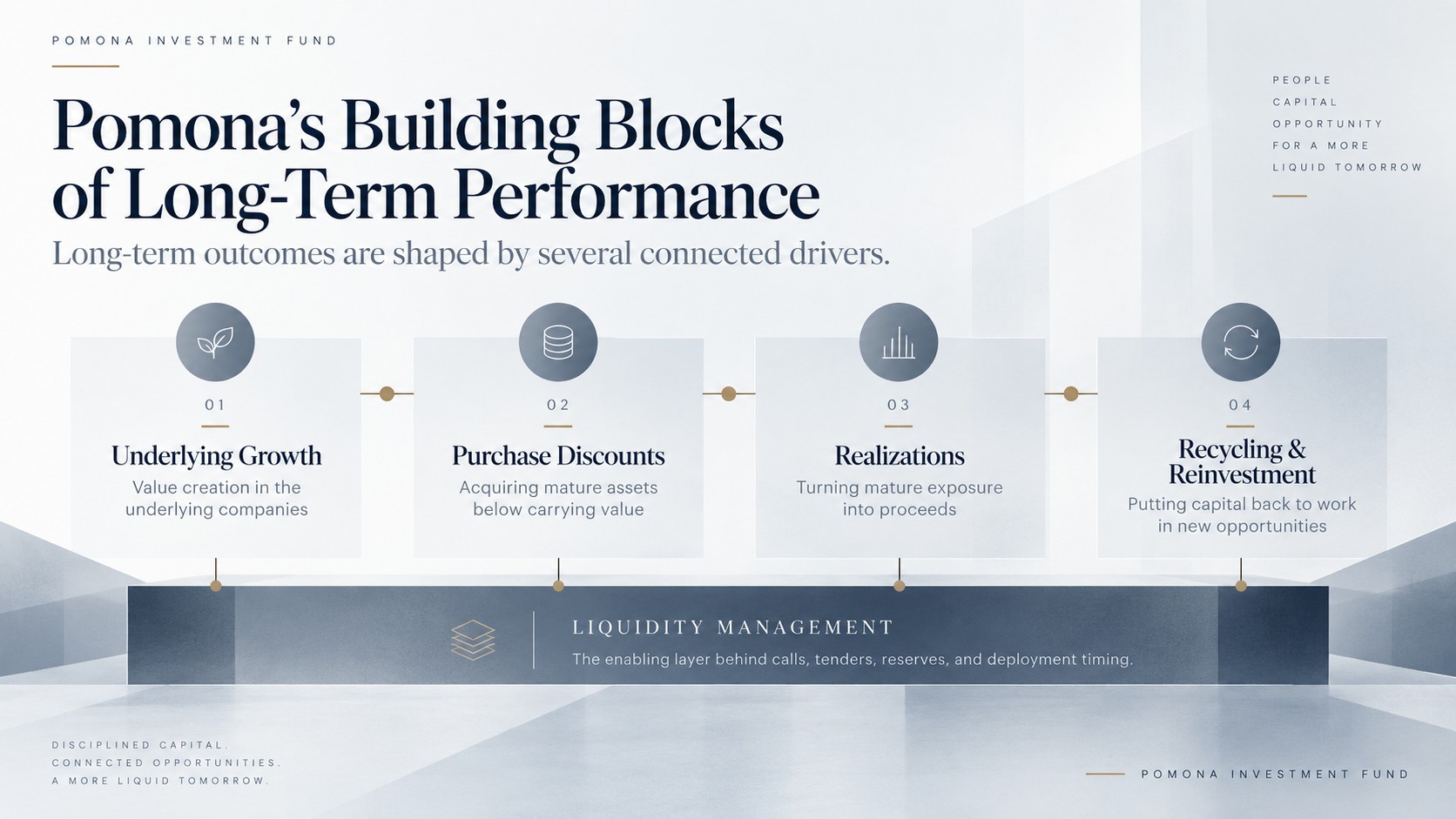
New purchases represent a smaller percentage of the total portfolio. As a result, the investment case increasingly depends on multiple connected drivers: underlying portfolio-company growth, purchase discounts, realizations, and the ability to recycle proceeds into new investments.
That creates a more durable framework for evaluating Pomona.
It also helps explain why the firm’s long operating history matters.
The strategy is not simply about sourcing transactions. It is about maintaining an investment system in which mature assets generate liquidity, liquidity is recycled, and new opportunities are continuously evaluated.
5. Our modeling continues to show attractive long-term economics
Our current deterministic research model produces a long-term Pomona return of approximately 12.8% annually under its existing acquisition and reinvestment assumptions.
That figure is not a forecast or guarantee. More useful than the point estimate is the sensitivity around it.
We tested how the model behaves when acquisition discounts on new secondary purchases are lower.
Under the current 21% acquisition-discount assumption, the model produces approximately 12.77% annualized return.
Using a lower acquisition discount of approximately 19.1%, the modeled return declines to 12.00%.
Using approximately 16.0%, it declines further to 10.87%.
That range tells us something important.
The return case remains meaningful even when acquisition economics become less favorable, but the ability to continue buying assets at attractive prices clearly matters.
The effect also becomes more moderate at the portfolio level.
For a hypothetical portfolio with a 20% Pomona allocation, our deterministic portfolio CAGR moves from approximately 9.28% under the 21% discount assumption, to 9.08% under the 19.1% case, and 8.80% under the 16.0% case.
This is one reason we prefer to think about Pomona as a portfolio component rather than judge the strategy solely by a standalone return number.
The key question is not whether every secondary transaction is acquired at the same discount. It is whether the platform can continue combining attractive purchase economics with underlying growth and disciplined recycling.
6. Liquidity management increasingly matters to the return engine
As evergreen funds mature, liquidity becomes part of investment management rather than simply an operational feature.
A mature secondary vehicle has several competing uses for capital: capital calls, new purchases, tender payments, reserves, shareholder distributions, and opportunistic deployment.
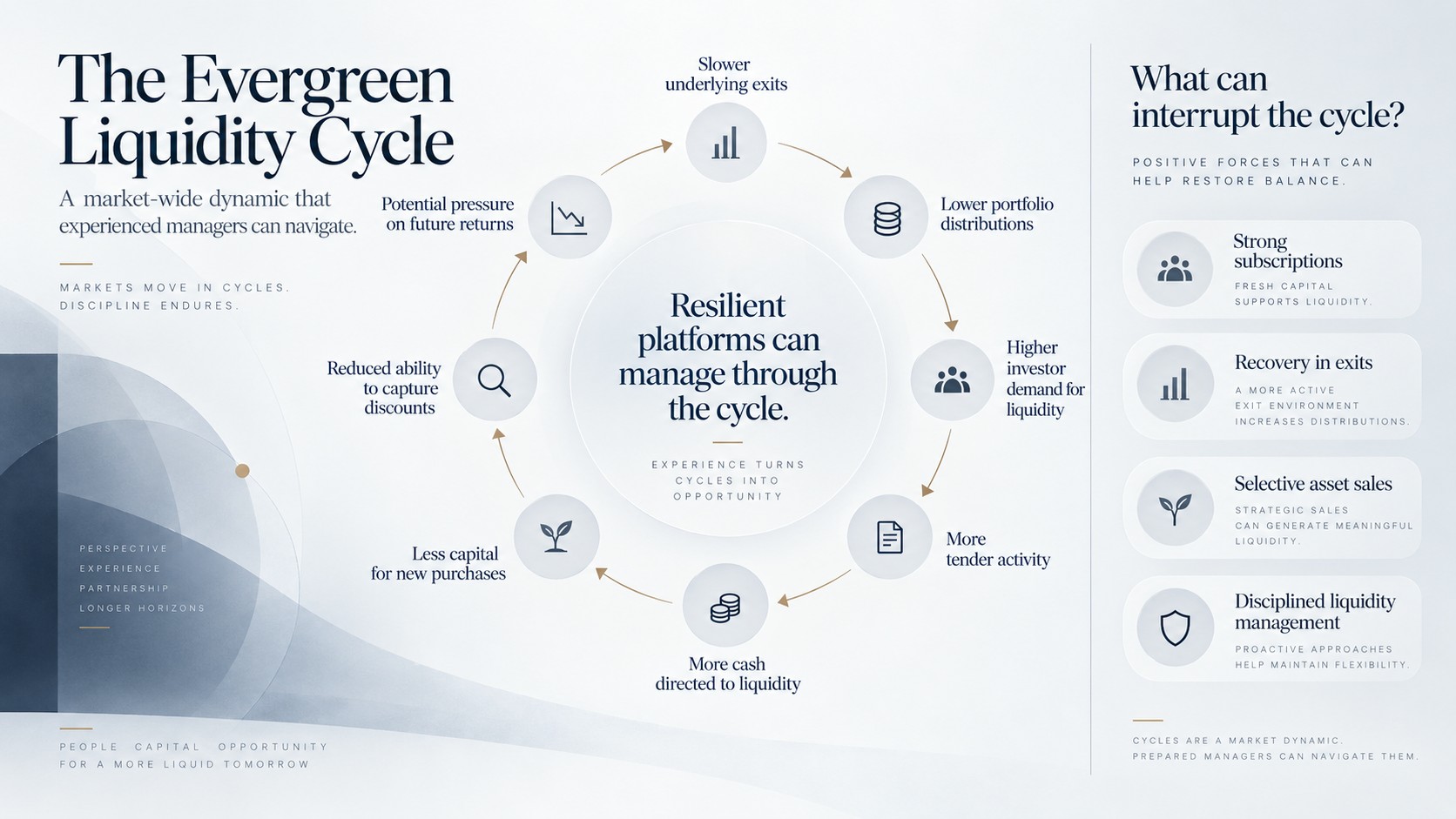
That creates what we think of as an Evergreen Liquidity Cycle.
The cycle can look like this: slower underlying exits lower portfolio distributions greater → → investor demand for liquidity higher tender activity more cash directed toward liquidity → → management less capital temporarily available for new purchases. →
The key word is temporarily.
This is a market cycle, not a one-way mechanism.
Several forces can restore balance: stronger subscriptions, recovering exit activity, selective asset sales, disciplined pacing, and flexible tender management.
Our structural work illustrates why those distinctions matter.
In one conditional 2025–2026 cash-flow scenario, the model’s planned purchases were approximately $30.69 per $100 of starting capital.
Using the historical underlying receipts and capital-call sequence alone, available cash supported approximately $22.21 of purchases.
When matching recent external-flow pressure was added under an immediate-payment convention, supported purchases fell to roughly $14.76.
With tender settlement spread over two quarters, the figure improved to approximately $16.86, and with three-quarter settlement, $18.63.
These are conditional modeling scenarios, not reconstructions of Pomona’s actual balance sheet.
But they demonstrate the mechanism clearly.
Liquidity management can affect how quickly capital is redeployed.
That does not mean the underlying assets have lost value. It means deployment timing matters.
For a secondary strategy, that matters because delayed deployment can reduce the amount of capital available to capture attractive new opportunities during a particular period.
7. The same liquidity environment is also creating more secondary opportunities
There is an important counterbalance.
The market conditions that create liquidity demands for investors are also helping drive record secondary-market activity.
With first-half 2026 secondary volume reaching approximately $120 billion, the market has become deeper and more diverse.
That creates a larger opportunity set for secondary specialists.
In other words, the same environment creates both greater liquidity-management requirements and more secondary transaction opportunities.
That is where manager selectivity becomes increasingly important.
More transactions do not automatically mean better transactions.
An experienced secondary buyer still has to determine which assets are attractive, which discounts reflect genuine value, which companies have meaningful underlying growth, and where future realizations are most likely.
Pomona’s long-standing emphasis on price and selectivity becomes particularly relevant in such an environment.
8. Competition for advisor capital is increasing
The wealth-management market has also changed significantly.
Pomona Investment Fund was launched at a time when individual investors and advisors had relatively few ways to access institutional-quality private-equity secondaries.
Today, the menu is substantially larger.
That is healthy for the market.
It gives advisors more choice and encourages managers to compete on portfolio quality, access, transparency, liquidity design, education, and long-term performance.
It also means subscriptions are naturally distributed across more vehicles.
That should not be confused with declining interest in the asset class.
The advisor survey data indicates that adoption of alternatives remains broad, with liquidity—not lack of interest—identified as the leading constraint on further allocation.
For Pomona, the challenge is therefore not simply to compete for capital.
It is to demonstrate why a mature, diversified secondaries platform deserves a role alongside newer products and more concentrated strategies.
That is a very different question.
And it is one Pomona is unusually well positioned to answer because of its operating history.
9. Why Pomona remains particularly interesting today
Pomona combines several characteristics that are difficult to replicate quickly.
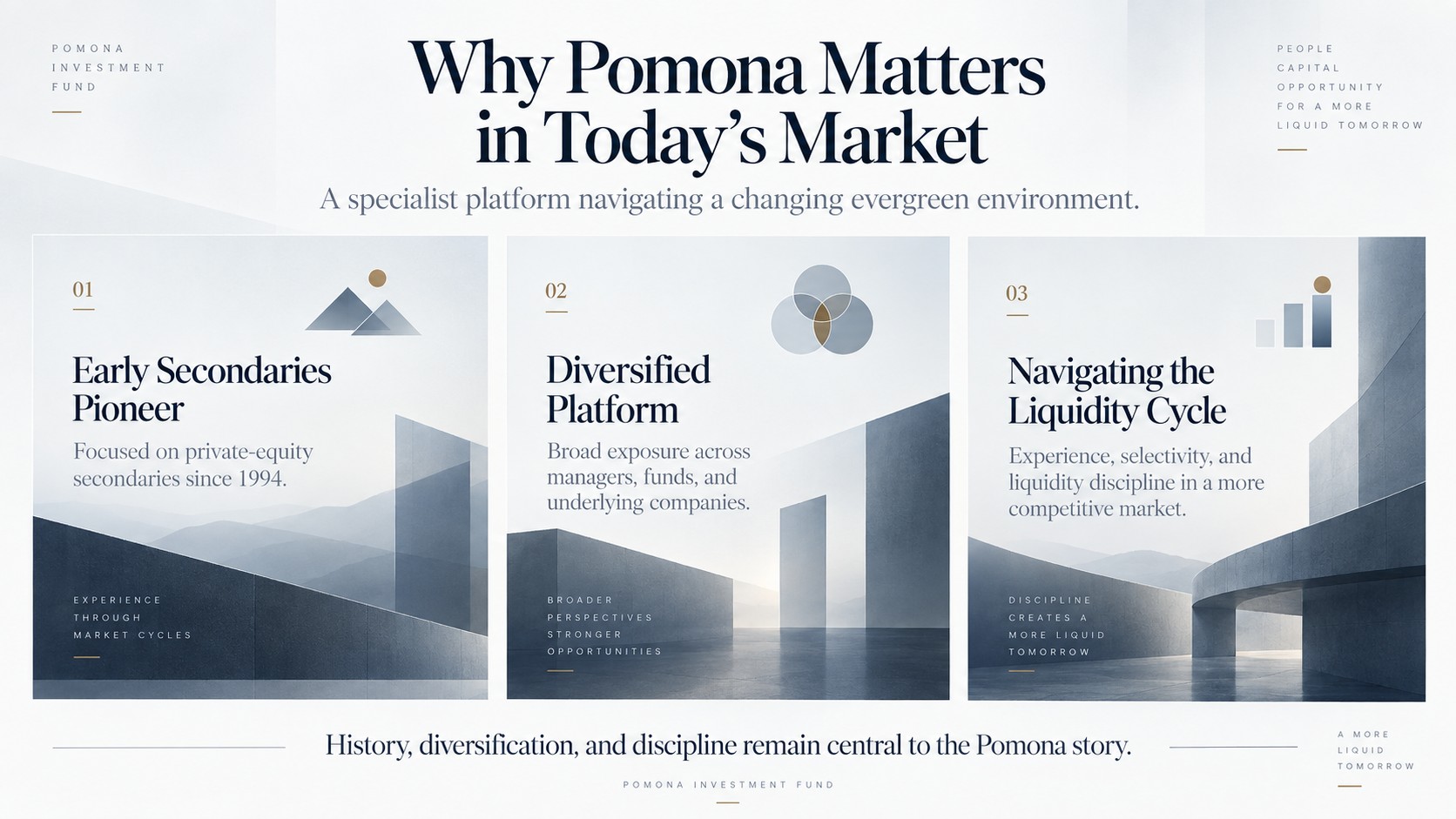
It is one of the early institutional pioneers of private-equity secondaries, a mature platform with decades of transaction history, a diversified secondary investor rather than a narrowly concentrated strategy, and a manager operating through multiple market cycles.
The firm itself describes its approach as purpose-built around creating mature, diversified portfolios of high-quality assets purchased at meaningful discounts, with enhanced liquidity and a lower-risk profile.
Our research adds an additional perspective.
We view the strategy as a combination of growth + pricing discipline + realizations + recycling, with liquidity management serving as the enabling layer beneath those components.
That framework is particularly relevant today.
When capital is abundant, liquidity management can appear secondary.
When exits slow, tenders rise, and competition for investor capital increases, it becomes much easier to see how important the full operating platform is.
10. What advisors should take away
Pomona Investment Fund is navigating a more competitive and more mature evergreen private-equity market.
That environment creates several important changes: investors are using liquidity features more actively; advisor capital is spread across a larger number of private-market products; and managers must balance shareholder liquidity with the ability to continue deploying capital.
At the same time, secondary-market transaction volume continues to expand, creating a broader opportunity set for experienced buyers.
For advisors, the key question is therefore not simply which fund has produced the highest recent return.
A more useful question is: Which platform has the experience, sourcing network, portfolio diversification, and liquidity discipline to keep its investment process working through different market cycles?
Pomona’s history makes it particularly relevant to that question.
The firm has been focused on secondaries since 1994.
It has built its platform over more than three decades.
And today it is operating in a market that increasingly rewards the same capabilities that have historically defined specialized secondaries investing: selectivity, relationships, disciplined pricing, diversification, and patience.
Conclusion
Evergreen private equity is becoming more competitive, more widely used, and more actively managed.
For Pomona, that evolution represents both a challenge and an opportunity.
Competition for advisor capital is greater than it was when the fund and the broader evergreen category were younger.
Liquidity management has become more important.
But the secondary market itself is also deeper, larger, and more active than ever.
Our modeling continues to find Pomona’s long-term economics attractive, while also showing that acquisition pricing and deployment capacity meaningfully influence outcomes.
That is exactly what we would expect from a mature secondaries strategy.
The next phase of the market is likely to reward managers that can do more than simply buy assets at a discount.
It will reward those that can source selectively, maintain diversified exposure, manage liquidity intelligently, and continue recycling capital through changing market conditions.
For Pomona, those capabilities are not new.
They are the product of more than three decades in the secondaries market.
Research note
This article reflects independent research by Alts Custodian using public fund disclosures, SEC filings, manager materials, and internal portfolio-modeling analysis. Model results are illustrative and are not forecasts, guarantees, investment recommendations, or manager-approved projections. Past performance does not guarantee future results.